Silver filigree in hand: reading wire work
Filigree looks like lace made of silver. It is built from fine wire, bent and soldered into shape, and good filigree takes hours of hand work. Here we read Turkish flower pendants and leaf bracelets that passed through our shop, to show what to look for.
Short answer: real filigree is made of fine wires soldered together, often with no solid base, so you can see light through the gaps and follow each wire with your eye. If the "wires" all run together into one smooth surface with a flat, solid back, it may be cast or cut from sheet to look like filigree. Hold it up to the light and look at the back.
What filigree is
Filigree is metalwork built from tiny beads or twisted threads of gold or silver, soldered together or onto a surface of the same metal. Openwork filigree has no solid base at all: the wires are soldered only to each other, which is why it often looks like lace. It should not be confused with pierced work, where holes are cut into a sheet of metal (Wikipedia: Filigree).
In Turkey, silver and gold wire work is called telkari. The same source traces it to Midyat, in Mardin Province, from the 15th century, and craftsmen there still make it.
1. The flower pendant
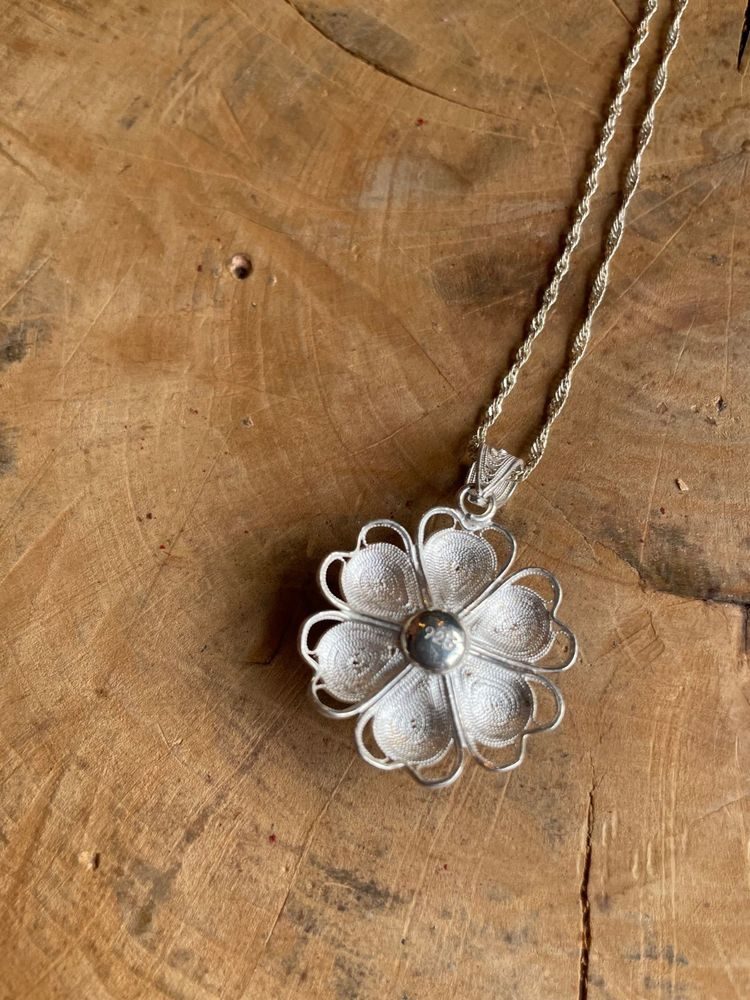
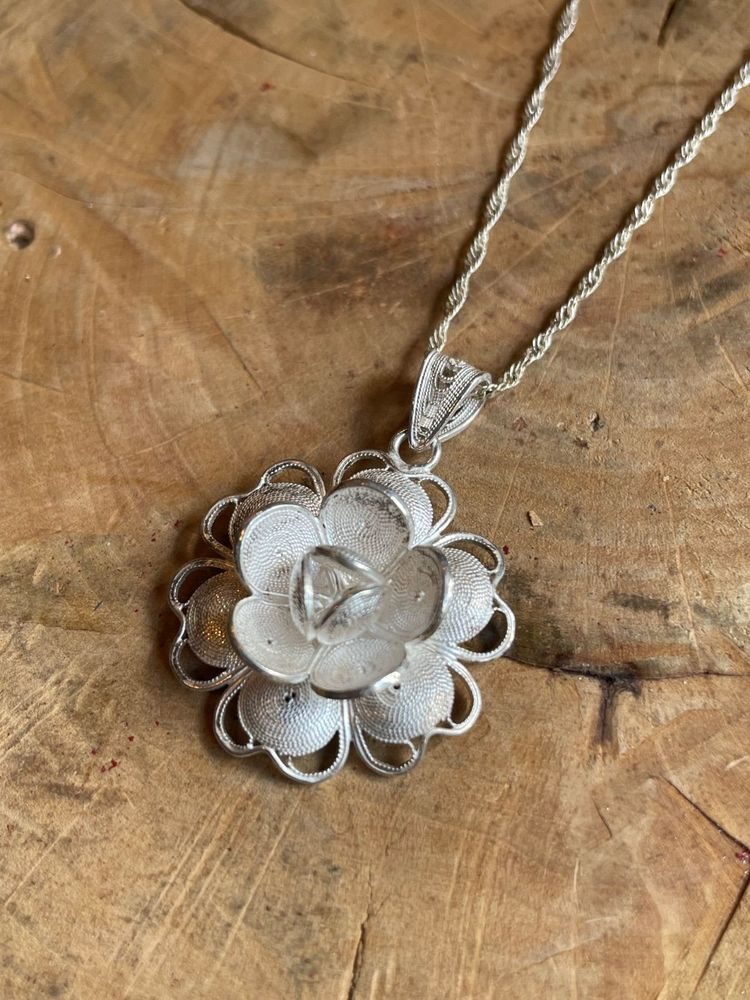
What to look at:
- Each petal has an outline. A heavier wire forms the edge of each petal, and finer wire is coiled inside it. You can follow the coils one by one.
- Layers. The petals are stacked in rows, not pressed from one piece.
- Dark in the gaps. Oxidation collects in the gaps between wires. It makes the pattern easier to read, and it polishes off if you prefer it bright.
2. The bracelet
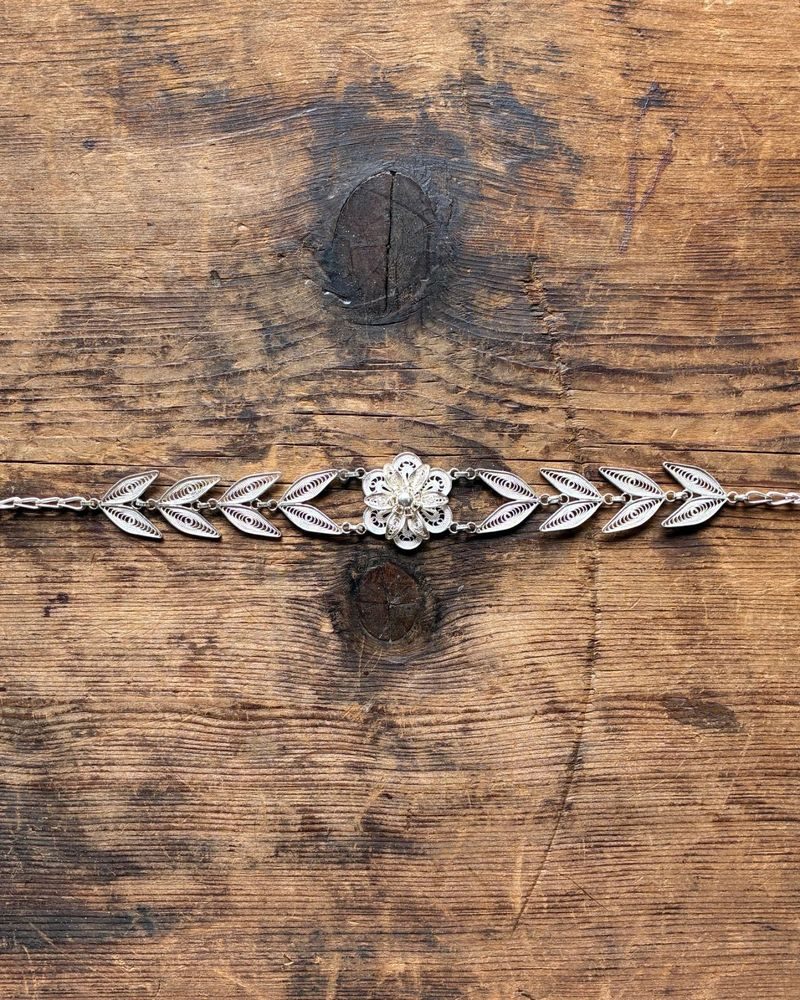
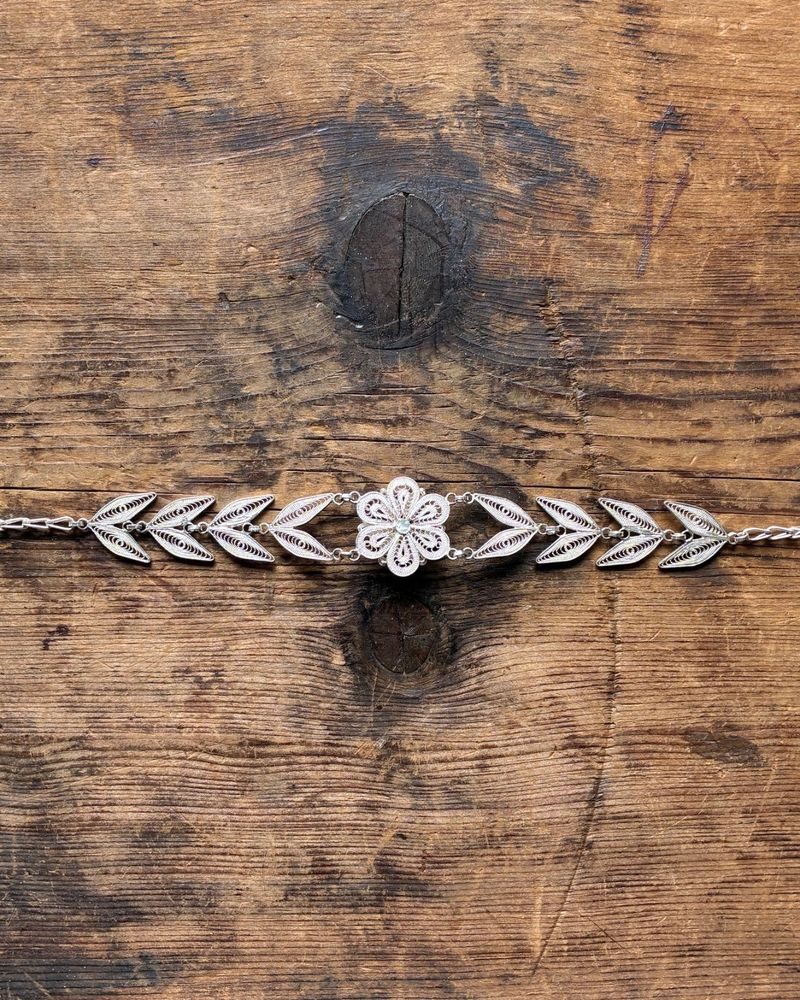
We bought this bracelet new in Ankara, sold to us as made by hand by a local craftsman. Each leaf is a frame of wire with finer wire set inside it and soldered in place. Hold one link up to a window and you can see light through the gaps between the strands. That openness is the clearest sign of wire work.
What we cannot tell you from a photo
A photo cannot prove the metal. Both pieces are sold as 925 silver, and we treat that as the seller's and our own claim until a stamp or a test confirms it. If you are buying filigree, ask for a photo of the stamp and a photo of the back. For what the numbers mean, read how to read hallmarks on vintage silver.
Both pieces are in our shop
We run a small vintage shop in Kawagoe, Japan (Old Pawn Notes and the shop are run by the same people). The shop page is in English; the detailed description is still in Japanese.
Sources
This guide was drafted with AI assistance from our own notes and photos, then checked by the shop owner. Every photo shows a real piece we handled. Any diagrams are simple drawings and are labelled as diagrams.